

Cellufine™ Phosphate HC
For purification of nucleic acid-binding proteins such as T7 RNA polymerase, which is an enzyme for synthesizing mRNA drugs
Cellufine™ Phosphate HC is an affinity chromatography resin used for the purification of nucleic acid–related proteins, such as protein kinases, restriction enzymes, nucleases, and polymerases. It consists of spherical cellulose beads onto which phosphate ester groups are immobilized.
Compared with conventional Cellufine™ Phosphate, the pore size has been optimized to enhance the binding capacity for higher-molecular-weight proteins (above 45 kDa). It is particularly suitable for the purification of large enzymes such as T7 RNA polymerase.
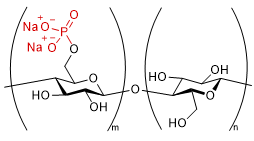
| Cellufine™ Phosphate | Cellufine™ Phosphate HC | |
|---|---|---|
| Ligand | Phosphate ester group | Phosphate ester group |
| Base matrix | Cellulose beads | |
| Particle size (μm) | 40 - 130 | |
| Exclusion limit molecular weight (kDa) | 30–40 | 150 |
| Ion exchange capacity (meq/mL-gel) | 0.3 - 0.8 | 0.2 - 0.8 |
| Lysozyme binding capacity (mg/mL-gel) | 140 | - |
| IgG binding capacity (mg/mL-gel) | - | 100 |
| Recommended operating pressure (MPa) | < 0.2 | |
| pH stability | 5 - 12 | |
| Storage conditions | 2–8 ℃ in 20% ethanol | |
Cellufine™ Phosphate HC Adsorption Performance
Protein binding capacities of Cellufine™ Phosphate HC and Cellufine™ Phosphate were compared using model proteins.
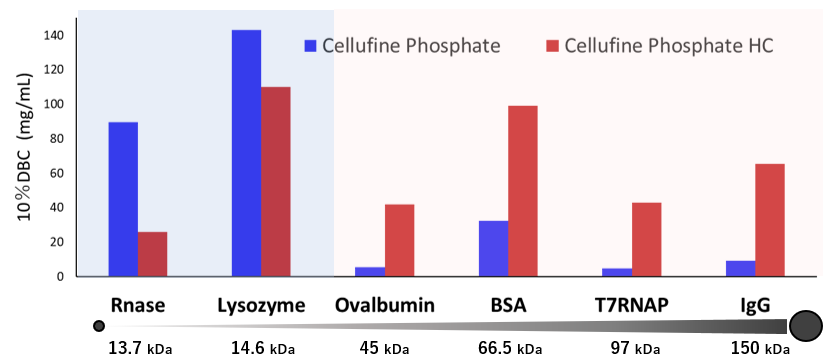
Cellufine™ Phosphate exhibits high binding capacity for low-molecular-weight proteins such as lysozyme. This is because its pore size is optimized for relatively small proteins.
In contrast, Cellufine™ Phosphate HC has extremely high binding capacity for proteins larger than 45 kDa. In particular, the binding capacity for T7 RNA polymerase, which is attracting attention for mRNA synthesis, is approximately 9 times higher than that of the conventional product.
Thus, these two phosphate resins can be selected according to the molecular weight of the target protein.
Purification of pyrophosphatase and vaccinia capping enzymes
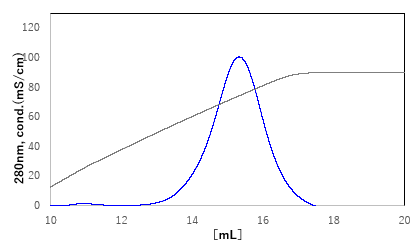
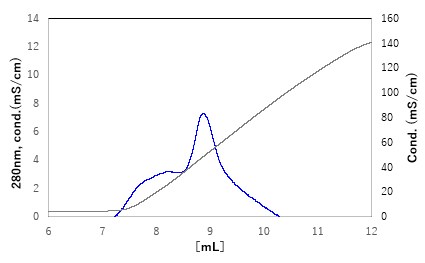
Cellufine™ Phosphate HC shows strong affinity not only for T7 RNA polymerase but also for enzymes such as pyrophosphatase and vaccinia capping enzyme. After loading pyrophosphatase onto a column equilibrated with 10 mM phosphate buffer (pH 7), the sodium chloride concentration was increased in a gradient, and the conductivity at elution was measured (Figure 3).
The conductivity at the elution peak of pyrophosphatase was 74.5 mS/cm (equivalent to 0.9 M NaCl), indicating strong binding. For vaccinia capping enzyme, the elution peak reached a maximum at 50 mS/cm (Figure 4).
At these salt concentrations, impurities bound by electrostatic interactions do not remain in the column. Therefore, enzymes with affinity activity can be effectively purified.
Purification example of T7 RNA polymerase
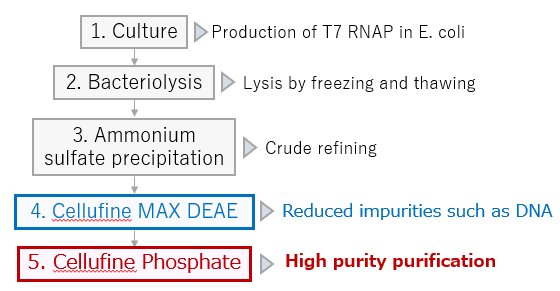
This is an example of high-purity purification of T7 RNA polymerase using Cellufine™ Phosphate HC and the anion exchange chromatography resin Cellufine™ MAX DEAE.
T7 RNA polymerase can be purified to high purity by applying pretreatment steps including cell lysis and ammonium sulfate precipitation, followed by chromatography with Cellufine™ MAX DEAE and Cellufine™ Phosphate HC, as shown in Figure 5.
| Purification step | Enzyme activity (U) |
Protein (ng/Unit) |
DNA (pg/Unit) |
|---|---|---|---|
| Load sample | - | 5.27 | 1.14 |
| Cellufine™ Phosphate | 626,816 | 1.53 | 0.58 |
| Cellufine™ Phosphate HC | 603,621 | 1.69 | 0.49 |
